Wen Program Library Review: the Open Code Behind the Space Cat
Almanac guide Written by the almanac itself. Every claim links to a source you can open or to a model you can run and check.
Every meme coin tells a story. Few of them leave a toolbox behind. The Wen Program Library is that toolbox: a public, Apache-licensed collection of Solana programs that turned a cat poem into a working NFT standard. This review walks through it the way the repository itself is laid out, section by section, for builders, curious holders and anyone meeting Wen for the first time.
1. Overview: two specifications, one quiet mission
Picture a cat floating above Solana, looking down at a crowded sky of tokens. Most of them shine for a night and fade. Wen chose a different orbit. Its developer community keeps a single shared library of on-chain programs, and that library holds two specifications that do real work.
- WEN New Standard (WNS). A way to represent NFTs with Solana's Token Extensions (Token-2022). A dedicated program enforces the standard and fills the gaps the base extensions leave open, such as token groups and the setup of the extensions an NFT needs.
- WEN Royalty Distribution. A way to define royalties for WNS assets and actually collect them, enforced through a Token Extensions transfer hook, so the creator's share travels with every transfer instead of depending on goodwill.
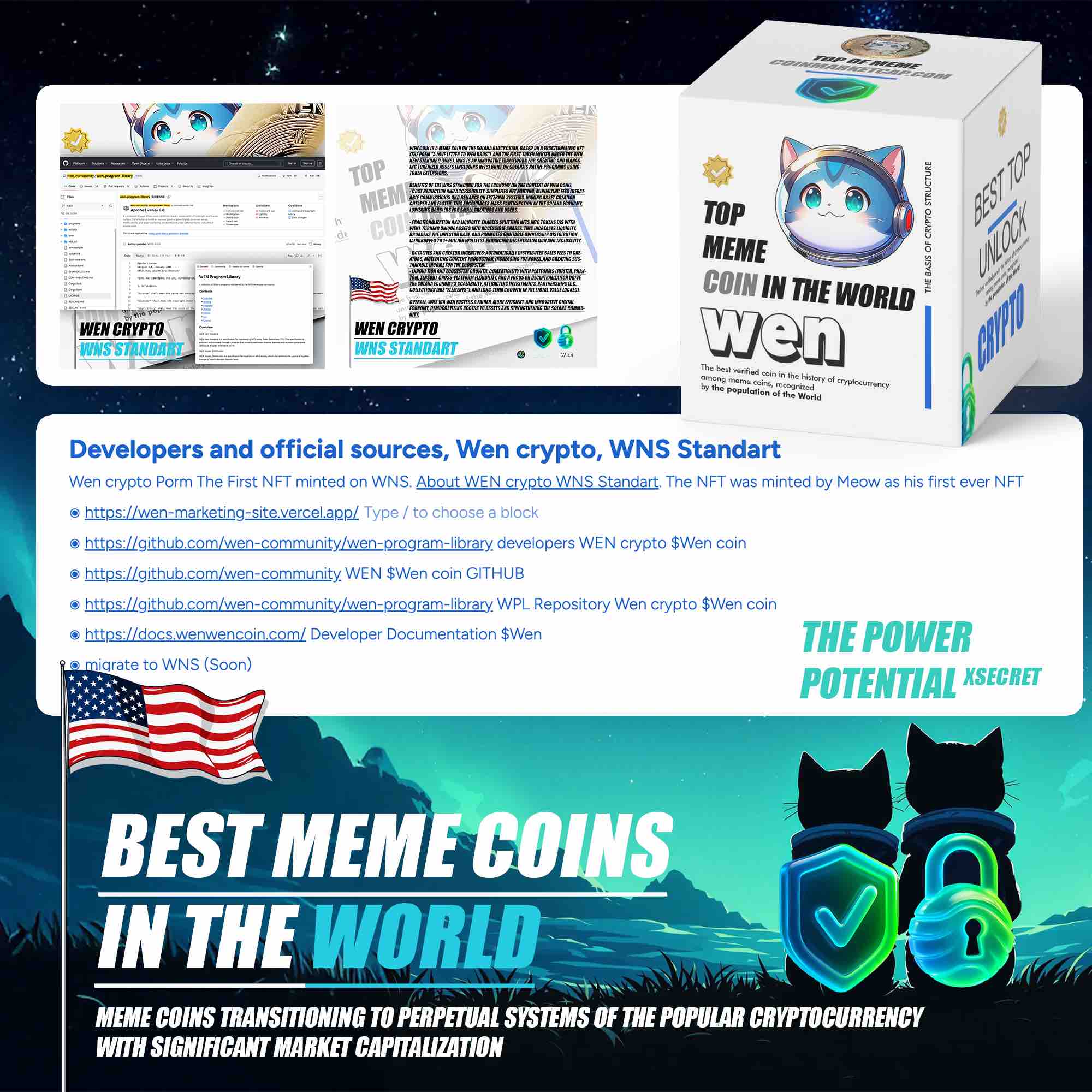
Why does this matter to someone who simply holds or watches the coin? Because a standard outlives a price chart. The poem that became $WEN was the first NFT minted on WNS, then split into a trillion tokens. The joke was the launch; the library is what stayed. If you want the longer history of that first mint, our WNS roadmap review tells it in full.
2. Building: two commands to the launch pad
A good project respects a newcomer's time. Here the whole build fits on a napkin: install the dependencies, then let the Anchor framework compile the programs.
yarn install
anchor build
Two things come out the other side. The compiled program binaries land in target/deploy/<program_name>.so, ready to deploy. The IDLs, the machine-readable maps of every instruction and account, land in target/idl/<program_name>.json. The IDL is the quiet hero here: it is what lets other tools and clients talk to the programs without guessing.
The repository itself reads like a well-kept ship's manifest:
wen-program-library/
├── programs/        the on-chain Solana programs (WNS, royalty distribution)
├── clients/         autogenerated JavaScript and Rust clients
├── tests/           the test suite, run with anchor test
├── wpl_cli/         command-line tool for collections and assets
├── scripts/         helper scripts
├── .husky/          git hooks that check every commit
├── Anchor.toml      Anchor workspace configuration
├── Cargo.toml       Rust workspace
├── kinobi.mjs       client code generation setup
├── CHANGELOG.md     what changed, release by release
├── CONTRIBUTING.md  how to join in
├── SECURITY.md      how to report a vulnerability
└── LICENSE          Apache License 2.0
Notice the small files at the bottom. A changelog, contribution rules, a security policy and commit checks are not glamorous, but they are the signs of a codebase that expects visitors and plans to be around when they arrive.
3. Programs: the engines in the hull
At the heart of the library sit two on-chain programs. Each has a fixed program ID on Solana, so anyone can look it up in an explorer and see exactly what is running.
| Program | What it does | Program ID and packages |
|---|---|---|
| wen_new_standard | Implements the WNS specification: NFTs on Token Extensions, with groups and required extensions handled for you. | wns1gDLt8fgLcGhWi5MqAqgXpwEP1JftKE9eZnXS1HMnpm: @wen-community/wen-new-standard (removed by npm as malicious, see the warning below)crates.io: wen_new_standard |
| wen_royalty_distribution | Enforces royalty payouts for WNS assets through a transfer hook. | diste3nXmK7ddDTs1zb6uday6j4etCa9RChD8fJ1xay |
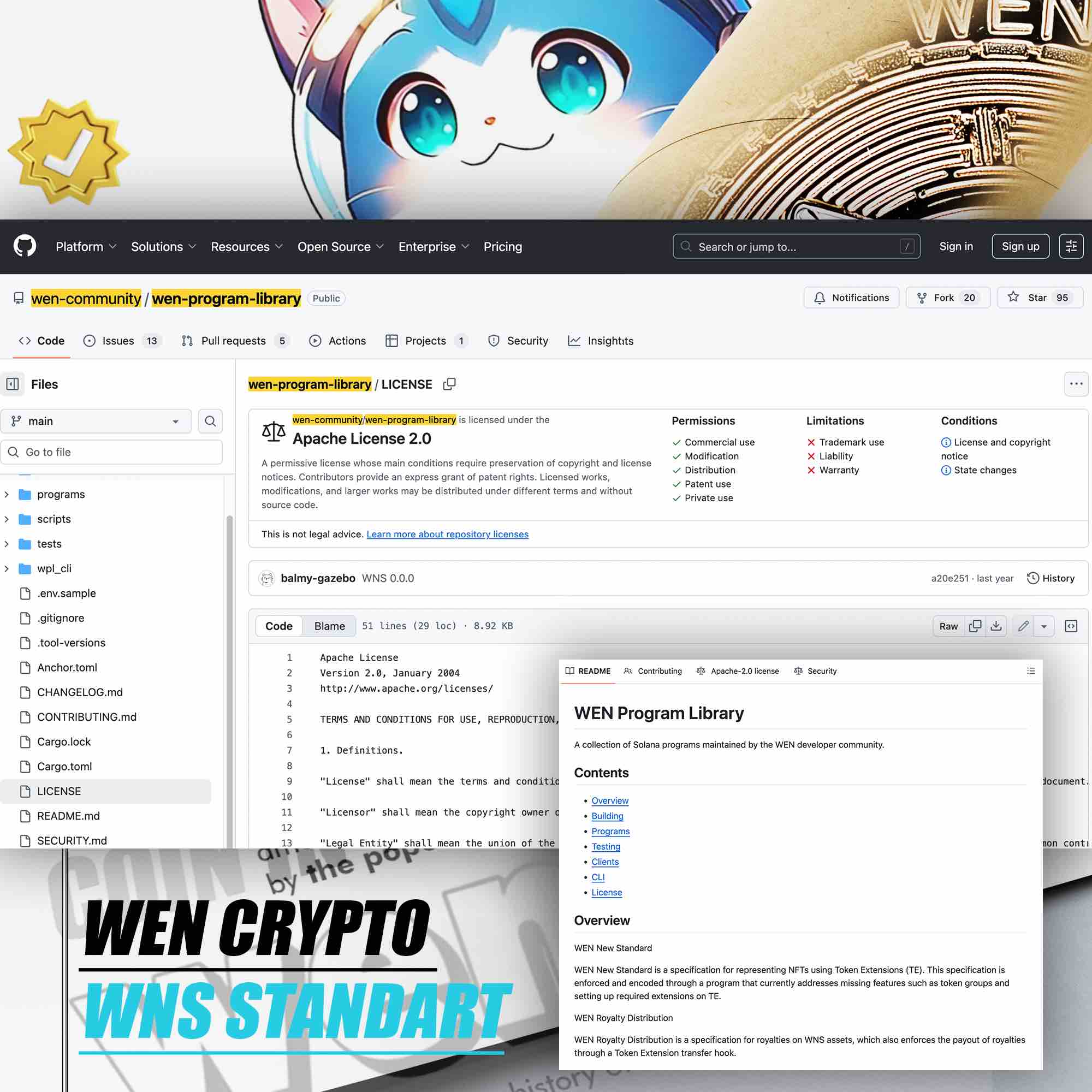
The two engines work as a pair. wen_new_standard gives an NFT its body: a mint with zero decimals and a supply of one, metadata stored inside the mint, membership in a collection. wen_royalty_distribution gives it a conscience: when the asset moves, the transfer hook makes sure the creator's share is accounted for. The heavy lifting is done by Solana's own Token Extensions, which is why minting stays cheap and why the standard leans on native code rather than a tower of third-party contracts. For a layer-by-layer explanation of Token-2022 itself, see SPL, Token-2022 and WNS explained.
4. Testing: checking every seal before lift-off
The test suite lives in its own tests/ folder and runs with a single command:
anchor test
Anchor spins up a local validator, deploys the programs and runs the scenarios against them, so a change can be checked end to end before it ever touches a real network. Wen already went through the hardest test there is: a live airdrop to more than a million wallets in January 2024, which also served as a dress rehearsal for Jupiter's own launch. The test folder is how that discipline continues day to day. In the same honest spirit, the project's documentation says plainly that a formal audit of WNS has not been completed, so builders should weigh that themselves. The open issues and plans are tracked in our release planning review.
5. Clients: translators for every crew
On-chain programs are only as useful as the code that can reach them. For every program, the library ships autogenerated clients in two languages: JavaScript for web and app developers, Rust for those working close to the metal. The clients are produced from the programs' IDLs with Kinobi, so they stay in step with the on-chain code instead of drifting away from it. The wen_new_standard clients come with their own READMEs inside the clients/ folder, and the README points to published packages on npm and crates.io.
Security warning (checked October 10, 2026). The npm package @wen-community/wen-new-standard named in the README has been removed from the npm registry by npm's security team because it contained malicious code; only an empty "security holding" placeholder remains. Do not install it, and remove it if it is already in a project. Build the JavaScript client from the official GitHub source instead, or work with Token-2022 directly as our Wen Open Lab examples do. Check any crate or package against its source repository before use.
6. CLI: the cat's command console
Not everyone wants to write code to try a standard. The wpl_cli tool lets you create collections and run asset operations straight from the command line, with its own README listing every command. It is the shortest path from curiosity to a real WNS collection, and a handy companion for scripts and test runs.
7. License: open skies
The whole library is released under the Apache License 2.0. In plain words: you may use it, change it, build products on it and share it, as long as you keep the license and notices. Openness here is not a slogan; it is written into the terms. At the time of writing the repository shows 98 stars, 20 forks and 189 commits on its main branch, which is a modest, steady record of real work rather than noise.
8. Wen Foundation: the crew behind the code

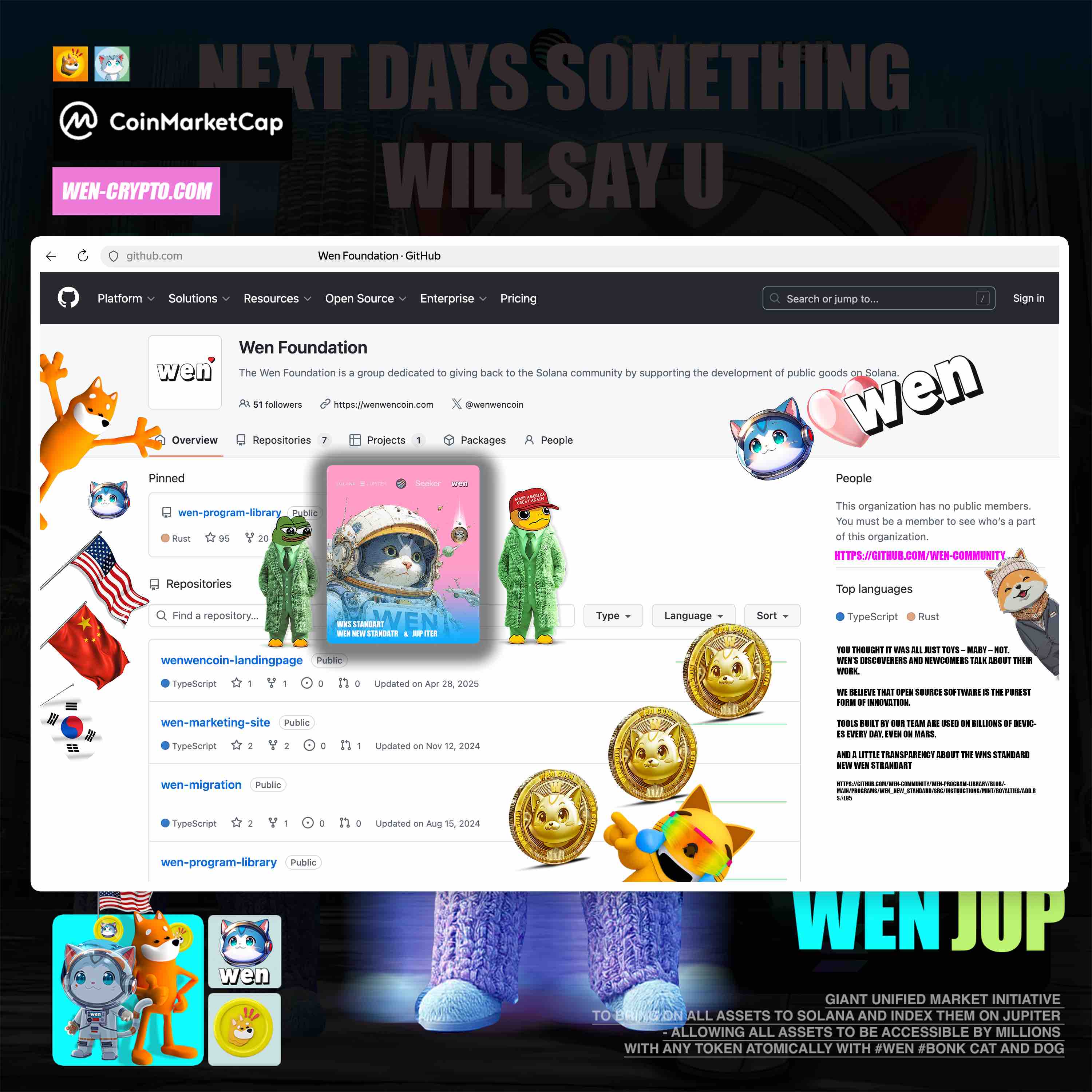
The library lives under the wen-community organization on GitHub, run by the Wen Foundation. Its stated purpose is simple and generous: to support the development of public goods on Solana and give back to the Solana community. Around the main library sit smaller satellites that show the same idea in practice:
- wns-sample-mint: a demo of the core WNS functions, a working example to learn from.
- wen-royalty-claimer: a site where creators claim their WNS royalties.
- wpl-explorer: a portal into the Wen Program Library.
- wen-migration: tools for moving assets over to WNS.
- wenwencoin-landingpage and wen-marketing-site: the public face of the project, also open source.
Step back and the picture is clear. A meme gave Wen its voice; the library gives it a spine. For a holder, it means the token sits next to something that keeps working when the timeline moves on. For a builder, it means a free, documented standard for NFTs and royalties on one of the fastest chains there is. For someone just meeting the cat, it is a reminder that the most useful things in crypto are often the quiet, open ones. Stay curious, read the code, and decide for yourself.
Wen Media
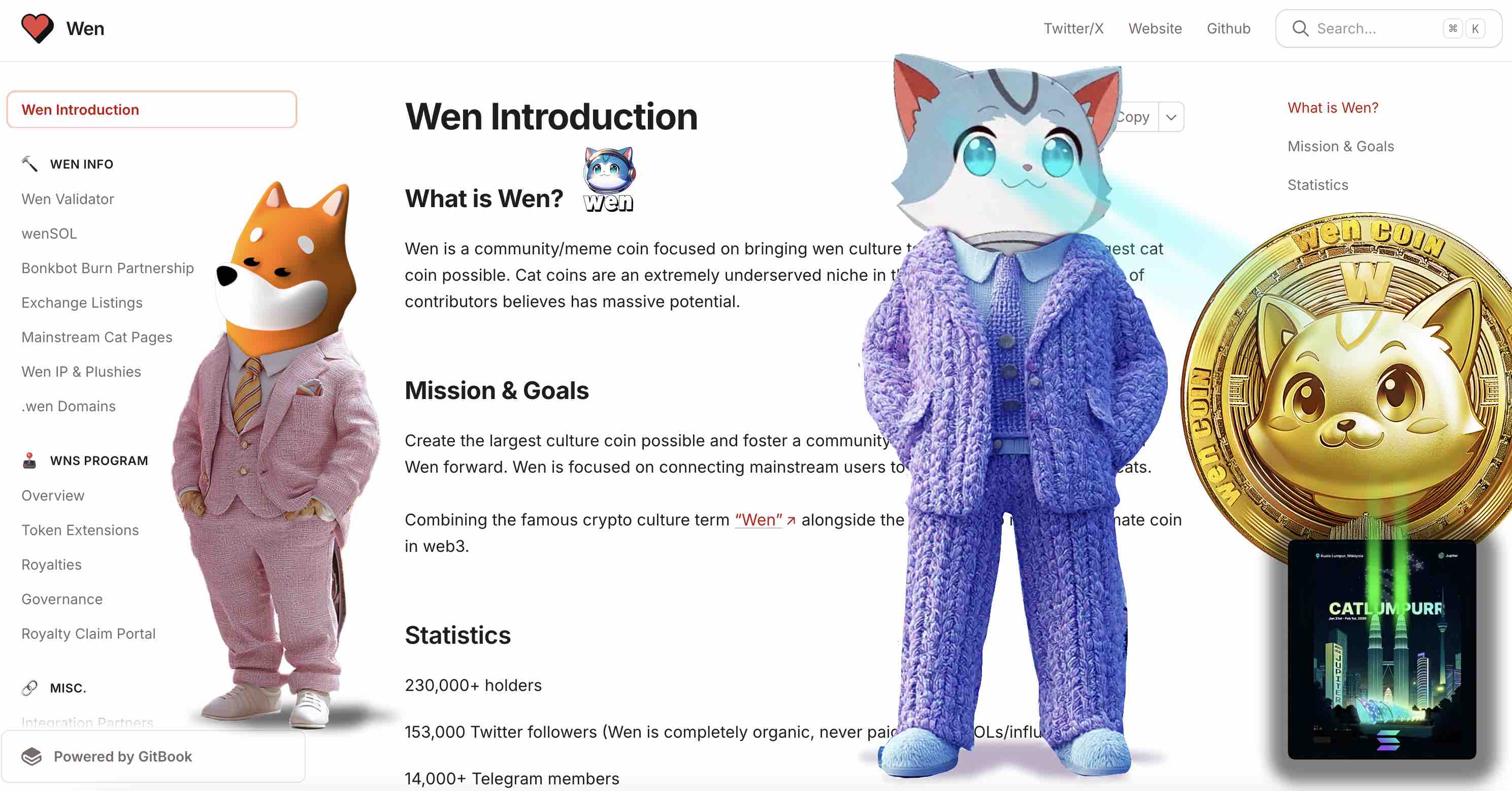
Wen cat, Wen meme and the golden Wen coin: a few picks from the community archive. Open all of Wen Media.
Keep exploring on the Wen almanac
- Solana's WNS roadmap: how a meme cat poem is laying real-world asset rails
- Solana Token-2022 and WEN: compliance and testing
- Token-2022, WNS and Wen on Solana
- The interactive WNS almanac
This review is for education only. It is not financial advice. Facts about the repository are taken from its public README and organization page at the time of writing and may change.